
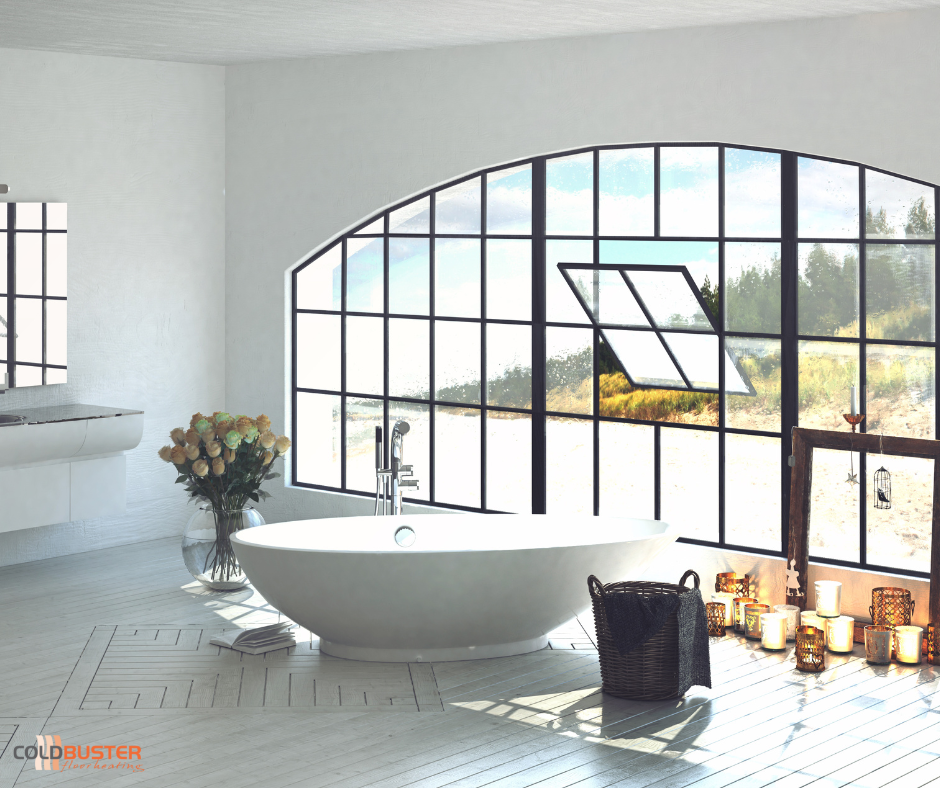
The use of underfloor heating systems is rapidly increasing, both in commercial and residential buildings. These systems are ideal for fulfilling your heating requirements because of their high level of efficiency and low cost, both of which are improved when used in combination with a programmable thermostat.
In essence, an underfloor heating system acts as a type of central heating to help regulate the temperature on the inside of your home.
Choosing underfloor heating for your home has several advantages.There are many ways to take advantage of this low-cost luxury, from warming the floor as you walk around your house or keeping your toes warm after you’ve taken a shower, to making it your primary source of house heating.
Most commonly found in bathrooms and other wet rooms, underfloor heating is a popular way for homeowners to maintain a consistently pleasant temperature year-round. It’s a great strategy, particularly in the winter, to focus on rooms that aren’t heated. Heated flooring is a viable alternative to your current heating system because it warms the entire room equally and effectively.
When deciding whether or not to opt for underfloor heating products in your house, it is important to know all of your options – including knowing all the different types of underfloor heating systems you can purchase.
In this article, we will discuss the two main types of underfloor heating.
Coldbuster underfloor heating is compatible with most type of floors. We would not recommend installing under 3 hardwood natural timbers (Ironbark, Spotted gum and Black butt) due to expansion/contraction. And of course you wouldn’t want to install under rubber or cork floors as the heat would not get through.
While they all serve the same basic purpose, different types of underfloor heating systems can be installed to provide a higher level of convenience, overall value, and comfort in a home. When stepping inside the bathroom during the winter, you won’t have to worry about your feet being cold on the tile.
Electric underfloor heating and hydronic underfloor heating (a water-based system) are the two most common kinds of such systems. The two are also commonly known as “dry” and “wet” systems, respectively.
Electric underfloor heating, also known as “dry” underfloor heating, is powered by your home’s electrical system. These typically involve wires with heating element attached to a floor. ‘ In comparison to a water-based system, this one is far more affordable due to the fact that the wires may be installed on top of the flooring rather than having to be fitted into it.
If you are not planning to upgrade the central heating system across your entire home, electric underfloor heating is a popular option for single rooms. Because the components may all be installed separately from each other, the system can be set up in a single room with minimal disruption to the rest of the house.
The following are some more advantages of this type of underfloor heating:
Depending on the size of the space and the insulation, electric underfloor heating systems can be more expensive to operate than hydronic heating systems, but they are simpler, cheaper to install and No maintenance costs associated. Let’s look at some of its disadvantages:
A water-based underfloor heating system is a network of pipes that are linked to a boiler and used to distribute warm water around a room. The heat from a hydronic underfloor heating system is relaxing, warm, and consistent. This is made possible by a complex system of pipes hidden beneath the flooring that circulate hot water.
New floor constructions are ideal for this type of underfloor heating system as they can be designed to accommodate the pipes and be properly insulated. In addition to being compatible with a solar water heater, it also works well in an open floor plan or as a whole-house solution.
Several more key advantages of hydronic underfloor heating are:
There are, however, potential drawbacks to installing an underfloor heating system.
Depending on the nature of your project and your financial constraints, the upfront cost could be rather enormous. For instance, if you are in the process of constructing a new home, you may find that other aspects of your project result in cost overruns. When thinking about installing underfloor heating, you need to compare the upfront cost against the continuous advantage that you will receive in many years to come.
When compared to the costs of installing other types of heating systems, the cost of installing electric underfloor heating is rather inexpensive. It is possible to install electrical underfloor heating quickly and at a reasonable cost; however, you must remember to include in the cost of labour, which could mean the cost for hiring electrical professionals to connect everything to the power system.
Meanwhile, as hydronic floor heating needs a more complicated technique, the installation process can be longer. The initial investment could be substantial, but keep in mind that the operating expenses will be lower in the long term. However the maintenance costs and other issues might be quite expensive.
All in all, once you’ve got electric underfloor heating installed, that will be pretty much it! One of the most significant advantages of installing an electric underfloor heating system is the fact that it is very simple to use. They demand minimal to nonexistent levels of upkeep (although there are maintenance considerations with hydronic floor heating). And you can simply manage your underfloor heating system with a click of the thermostat control.
Suitability with the floor finish-
Installation
Thermostat type – we have many types of thermostat like basic, manual, programmable, wifi, smart and more.
Warranty – In general Electric underfloor heating systems have a warranty of 10-20 years. However, Coldbuster floor heating offers a 25-year manufacturers warranty on floor heating cable. Coldbuster floor heating product warranty is detailed in the ‘installation guide’ sent with every heating kit.
After sales support – This is a vital factor to consider, as customers might need help to reprogramme their thermostat, replace/upgrade their thermostat, fix a damaged underfloor heating system. At, Coldbuster floor heating we promise lifetime support as we value our customers deeply and consider ourselves highly reliable when it comes to customer support.
Type of floor slab.
There is a good probability that you will be constructing a new concrete floor slab when constructing a new house. A floor slab may already exist, though, if you are renovating an old building. By tying a new slab to the steel reinforcing mesh, it will facilitate the pipework installation process. The mesh must be in place before the pipes can be set up for the concrete pour — this is where you can set up the hydronic pipework in the concrete floor.
Heat sources.
Additionally, you should think about the kind of heat source you want to employ. It is common practice in Australia to use gas boilers to power hydronic radiant floor heating systems because they are the most affordable to set up. But because the price of gas has been rising, running expenses are not as low as they once were.
Whether you go with renewable or nonrenewable energy depends on a number of factors, including your budget, the availability of gas, how long you will live in the property, and your personal choice. The operational costs for electric underfloor heating becomes negligible when it is powered by solar energy.
Size of the space.
Underfloor heating is a standard feature for European homeowners. On the other hand, many Aussies would rather keep their bedrooms cool in the winter and turn on the underfloor heating only when it gets wet, as in the bathroom or the living room.
As a general rule, electric underfloor heating is preferable if you only need to heat bathrooms. The reason for this is that the space is quite tiny (often ranging from 2 to 3 square metres) and is rarely used for extended periods of time.
On the other hand, a hydronic system is typically the most cost-effective long-term option when heating a large, open space like a living room and dining area.
There are a number of different types of floor heating systems available for residential use. While some can be costly to maintain, they provide cleaner, more sustainable options. In either case, they improve the quality of life in a dwelling by increasing its overall value, aesthetic appeal, and level of comfort. And to get high-quality under tile heating kits, look no further than Coldbuster Floorheating!
At Coldbuster, we have an in-house team that services the Sydney area and a network of preferred installers across Australia. These professional teams are expert in underfloor heating installation of Coldbuster products and can work in unison with your electrician to provide a safe quick installation process.
Check the estimated cost of underfloor heating with our calculator that can help give you a very approximate idea of the cost of running underfloor heating. Adjust the numbers in the white cells to get a ballpark estimate of the monthly running cost of your floor heating system.
Remember that the numbers will only illustrate a typical heater and its approximate running costs and do not reflect your quote. If any of these inputs does not accurately reflect your circumstances, please adjust them.
Give us a call on 1800 85 75 65 if you are unsure about which product to buy then you can always get a FREE quote. Whatever your project needs, we have the team to help and support you in any way.